
The Poet Painter
Information
Press
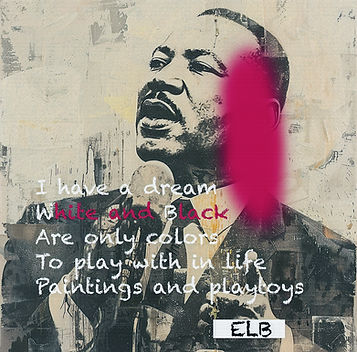


"I Have a Dream" Story:
The canvas depicted Dr. Martin Luther King Jr., his image rendered with a powerful, almost stencil-like quality, set against a stark, textured background. A bold, vibrant pink stripe cut across the painting, a striking visual element that seemed to punctuate the profound words scrawled across his figure. The poem, like a whispered mantra from the heart of the painting, began: "I have a dream". These words, instantly recognizable, invoked the spirit of a movement, a yearning for justice and equality. But then, the poem shifted, offering a new perspective on difference: "White and Black / Are only colors / To play with in Life". This wasn't a dismissal of history or struggle, but a reimagining of how we perceive distinctions. The vibrant pink stroke, perhaps, symbolized the vivid imagination needed to see beyond division, to embrace a world where differences were celebrated, not weaponized. The poem concluded with a simple, profound truth: "Paintings and playtoys". It suggested that just as artists use a spectrum of colors to create beauty on a canvas, and children use diverse colors in their innocent play, so too should humanity view its varied hues – not as barriers, but as elements for rich, harmonious creation in the grand tapestry of life. The story of this painting, then, is a continuation of Dr. King's enduring dream. It speaks of a future where the lines that divide people by skin color are seen not as rigid boundaries, but as artistic strokes, meant to inspire creativity and unity. It's a reminder that beneath the surface of historical pain and societal constructs, humanity shares a fundamental desire for harmony, a world where the beautiful diversity of "White and Black" contributes to a vibrant, shared existence, just like colors in a master's painting or cherished playthings.
The Poet's Words

I have a dream
White and Black
Are only colors
To play with in
Life Paintings
and playtoys
E. Laurence Bake